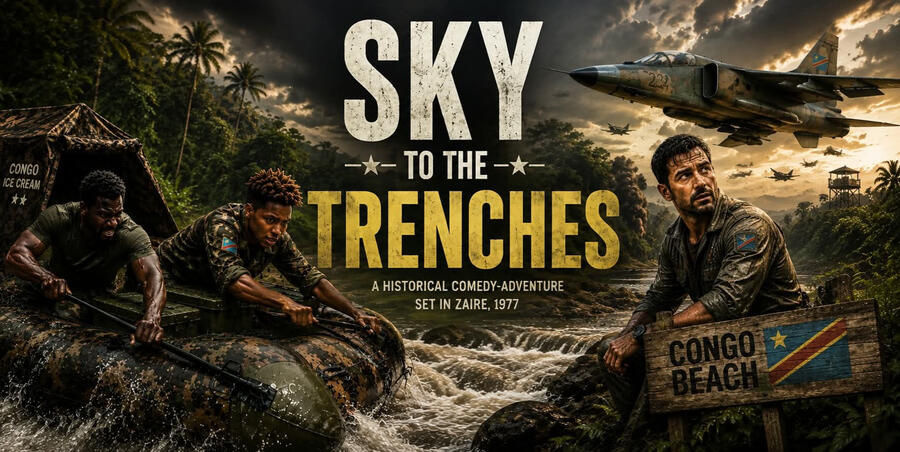
SKY TO THE TRENCHES
Two airmen. One routine mission. Everything is about to go wrong.
A historical military comedy-adventure set against the First Shaba War in Zaire, 1977.
RELEASING 16 NOVEMBER 2026
JOIN THE MAILING LIST
Read the first three chapters free. Get behind-the-scenes updates, character reels and publication news for Sky to the Trenches — straight to your inbox.
ABOUT THE BOOKZaire, 1977. The First Shaba War.
Manny and Horacio are two military airmen from very different backgrounds, united by friendship, flying — and an extraordinary ability to turn even the most serious situation into complete chaos.
What begins as a routine patrol rapidly becomes a fight for survival when everything goes catastrophically wrong.
Stranded far from safety and surrounded by conflict, the two men must somehow find their way home.
War is dangerous. Survival is difficult. Doing either with Horacio is considerably worse.
MEET MANNY AND HORACIO
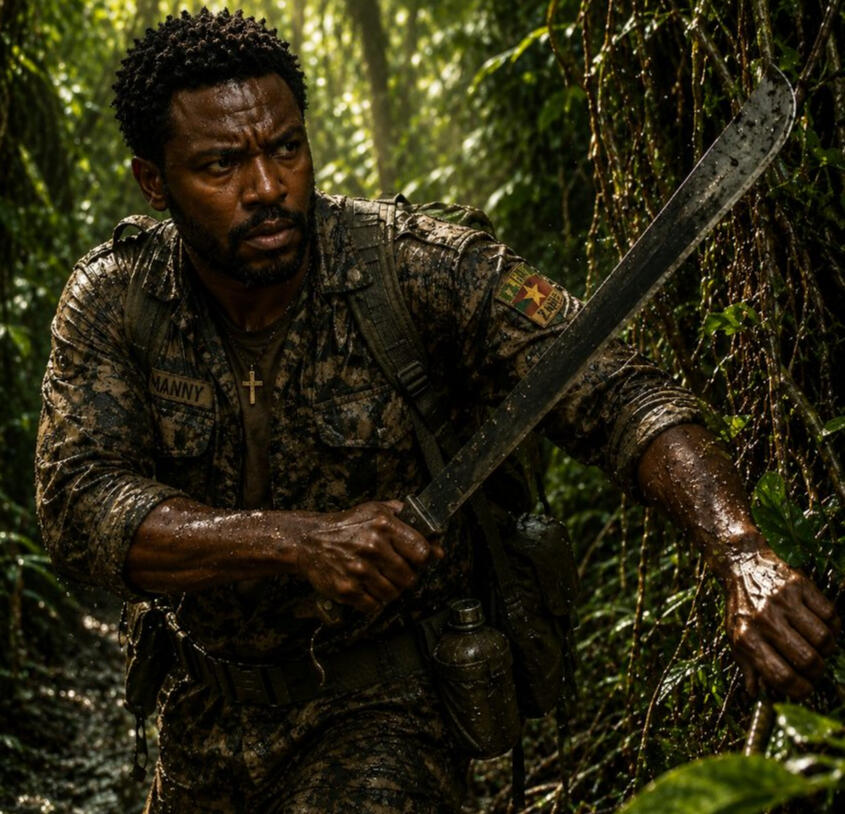
MANNY
A Ghanaian military airman, grounded, loyal and guided by faith, Manny is usually the one trying to keep things sensible. Usually. Put him next to Horacio for long enough and even Manny can end up making a bad situation considerably worse.
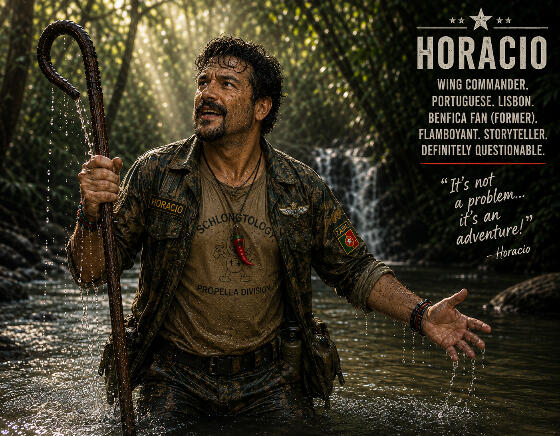
HORACIO
A Portuguese Wing Commander, unpredictable and incapable of leaving a perfectly normal situation alone. Horacio can turn almost anything into a ridiculous story, but underneath the chaos is someone Manny will eventually trust with his life.
WHAT READERS ARE SAYING
“I laughed at Horacio while still worrying about whether these two were going to survive.”
— Beta reader
“Their friendship has something about it that feels quite warm and genuine underneath all the nonsense.”
— Beta reader
“The serious Ghanaian officer versus the chaotic Portuguese officer is a good foundation.”
— Beta reader
ABOUT THE AUTHOR
Geoffrey Barrett is a UK-based first-time author and the creator of Sky to the Trenches, a historical military comedy-adventure set during the First Shaba War in Zaire in 1977.
Inspired by real personalities, workplace humour and a love of character-driven adventure, he began developing the story around Manny and Horacio and the ridiculous situations they somehow survive.
His research into the conflict, military aviation and 1970s Zaire provides the historical backdrop to their adventure.
JOIN THE MAILING LIST
THE HISTORY BEHIND THE STORY
The First Shaba War — Zaire, 1977
Sky to the Trenches is a work of fiction, but the conflict surrounding Manny and Horacio was very real.
In March 1977, fighters of the Front for the National Liberation of the Congo (FLNC), largely drawn from exiled Katangan forces, crossed from Angola into Zaire’s Shaba region. The offensive became known as the First Shaba War.
Today, the conflict is often overshadowed by the dramatic events at Kolwezi during the Second Shaba War the following year. But in 1977, fighting in Shaba brought rebellion, international military intervention and Cold War tensions into one of Zaire’s most economically important regions.
WHY SHABA?
Shaba — previously known as Katanga — was enormously important to Zaire because of its mineral wealth. The region was a major producer of copper and cobalt, and Kolwezi was one of its key mining centres.
During the 1977 offensive, FLNC forces captured towns in southwestern Shaba and advanced towards Kolwezi, bringing the fighting closer to the heart of Zaire’s mining industry.
WHO WERE THE FLNC?
The Front for the National Liberation of the Congo (FLNC) had roots in the turbulent years following Congolese independence. Its forces included former members of the Katangan gendarmerie who had gone into exile in Angola after earlier conflicts in the Congo.
On 8 March 1977, FLNC fighters crossed from Angola into Shaba. Their forces initially made rapid gains, but the broader uprising they hoped to encourage inside the region did not develop on the scale they expected.
THE INTERNATIONAL RESPONSE
As the crisis deepened, Zaire sought help from abroad. In April 1977, Morocco sent troops to support the Zairian forces, while France, Belgium and the United States were also involved in various forms of military, logistical or material support.
Contemporary diplomatic records show Moroccan troops being flown to Zaire and moved towards Kolwezi, while the United States considered requests for transport, medical supplies, food and other logistical assistance.
The conflict unfolded against the wider tensions of the Cold War. Claims about the involvement of Angola, Cuba and the Soviet Union were politically contentious at the time, and contemporary sources did not always agree about what could be firmly established.
WAR IN THE AIR
Aviation played an important role during the First Shaba War. Zaire’s air force operated both transport aircraft and combat aircraft during the fighting, although contemporary assessments were sharply critical of the effectiveness of its attack operations.
Its C-130 transport aircraft were a different story. Contemporary U.S. records described Zaire’s transport wing as performing well, moving men and supplies across the enormous distances involved in the campaign. Moroccan troops arriving to support Zaire were also transported from Lubumbashi towards Kolwezi aboard Zairian C-130s.
Perhaps surprisingly, the psychological effect of Zairian aircraft could be greater than the physical damage they caused. A May 1977 intelligence report based on accounts from former Katangan gendarmes said the appearance of Zairian aircraft seriously affected FLNC morale. Attempts to counter them with SAM-7 surface-to-air missiles and heavy machine guns were reported as largely ineffective.
That combination of aircraft, difficult logistics and an unpredictable conflict provides part of the historical atmosphere behind the aviation story in Sky to the Trenches.
FACT AND FICTION
Sky to the Trenches does not attempt to retell the First Shaba War as a documentary history.
Manny, Horacio and their adventure are fictional. Their friendship, disasters and ridiculous situations belong to the novel.
The war around them did not.
The real events of Shaba in 1977 provide the historical backdrop — a little-known conflict in which rebellion, military aviation, international intervention and Cold War politics collided in Central Africa.
SOURCES & FURTHER READING
Historical background for this page was researched using contemporary and declassified records, including the U.S. Department of State’s Foreign Relations of the United States collection and U.S. intelligence records relating to the First Shaba War.
These sources provide contemporary accounts of the fighting, international involvement, military logistics and aviation during the 1977 conflict.
U.S. State Department — Shaba, April 1977U.S. Intelligence Report — Shaba, May 1977